


Many candidates who participated in the 2026 admission exercise are beginning to wonder why admission for courses such as Medicine and Surgery, Law, Nursing, Engineering, Pharmacy and other professional programmes is yet to show as “Admission in Progress” on the JAMB Central Admission Processing System (CAPS).
While candidates may be worried about the delay, it is important to understand that professional courses are not handled in exactly the same way as ordinary or unregulated programmes.
Why Is Admission for Professional Courses Different?
Professional programmes are regulated by specific professional regulatory bodies in Nigeria. These bodies are responsible for setting and enforcing standards for training, accreditation, professional education and, in many cases, the number of students that institutions are permitted to admit into particular programmes.
Unlike some unregulated courses where universities may have greater flexibility in determining their admission capacity, universities cannot simply decide to increase the number of students they want to admit into regulated professional programmes.
The available admission quota for these programmes must take into consideration the requirements and approvals of the relevant regulatory bodies, as well as the admission policies and processes of the Joint Admissions and Matriculation Board (JAMB).
Regulatory Bodies and the Courses They Regulate
Some of the major professional regulatory bodies involved in university programmes include:
Medical and Dental Council of Nigeria (MDCN) — regulates Medicine and Surgery, Dentistry and other medical and dental training programmes.
Nursing and Midwifery Council of Nigeria (NMCN) — regulates Nursing Science and Midwifery education and professional practice.
Pharmacy Council of Nigeria (PCN) — regulates Pharmacy education and the pharmacy profession.
Council for Legal Education (CLE) — oversees legal education and the training of students for the legal profession in Nigeria, including the administration of the Nigerian Law School system.
Council for the Regulation of Engineering in Nigeria (COREN) — regulates engineering education and the engineering profession, including accreditation and standards for engineering programmes.
Veterinary Council of Nigeria (VCN) — regulates Veterinary Medicine and the veterinary profession.
Medical Laboratory Science Council of Nigeria (MLSCN) — regulates Medical Laboratory Science education and professional practice.
Optometrists and Dispensing Opticians Registration Board of Nigeria (ODOBRN) — regulates Optometry and Dispensing Opticianry.
These regulatory bodies help ensure that universities have the required facilities, qualified personnel, equipment and other resources before they can train students for professional practice.
Universities Cannot Set Professional Course Quotas Alone
One of the major reasons for the delay in admission processing for these programmes is the issue of admission quota.
For regulated professional courses, universities cannot simply determine their student intake based solely on their own preferred number. The capacity of a programme can be affected by factors such as available facilities, teaching staff, clinical training spaces, accreditation status and other requirements established by the relevant regulatory body.
This means that a university may be able to admit a large number of students into certain unregulated programmes but may have a much smaller approved capacity for a professional programme.
For example, a university may have the facilities to admit hundreds of students into an ordinary degree programme, but its approved capacity for Medicine, Nursing or Pharmacy may be significantly lower because of the additional regulatory and professional requirements attached to those programmes.
The Role of JAMB in the Admission Process
JAMB plays a central role in coordinating admissions into tertiary institutions through the Central Admission Processing System (CAPS).
However, the admission process for regulated professional programmes involves more than simply meeting a university's internal admission requirements.
The relevant regulatory body must ensure that the programme and its capacity meet the necessary professional standards, while JAMB coordinates the admission process within the broader framework of its mandate and approved institutional quotas.
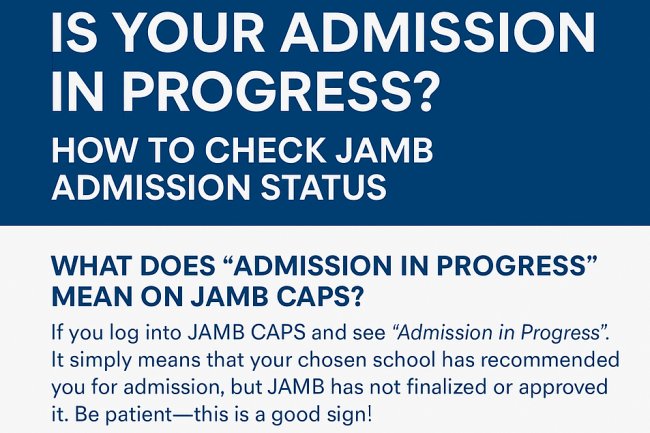
Therefore, candidates should not necessarily interpret the absence of “Admission in Progress” on CAPS as a rejection.
In many cases, it may simply mean that the institution and the relevant authorities are still completing the necessary processes before admissions can be fully processed and reflected on CAPS.
Why Candidates Should Not Panic
Candidates who applied for professional programmes should therefore exercise patience and continue monitoring their JAMB CAPS profiles.
The fact that admission has not yet appeared does not automatically mean that a candidate has lost the opportunity to gain admission.
Professional programmes often require additional layers of verification, accreditation, quota consideration and coordination between the university, the relevant regulatory body and JAMB.
Once the necessary approvals and admission lists are finalized and uploaded for processing, candidates who are successfully recommended for admission should begin to see the appropriate changes on their CAPS profiles.








Leave a comment